

How Many Carbs Do You Actually Need Per Hour of Exercise?
Shop the gear in this story
per hour?
 1 / 62 / 6
to the run
3 / 6can take 90g
4 / 6needs training too
5 / 6your race day
6 / 6The Short Version
- Runs of about an hour need little or no fuel.
- For two to three hours, work up to about 60g of carbs an hour. That is a 26g ANS gel roughly every 25 minutes.
- Going past 60g only works with a mix of carb types, and your gut needs training to cope.
"Eat more carbs" is the most repeated advice in endurance sport. It is also useless at 9pm the night before a 30km long run, when you are staring at a drawer of gels and trying to work out how many to stuff in your pockets.
You want a number. The good news is that sports scientists have one, and it depends on two things: how long you will be out, and how much your gut can absorb.

Photo: SportPlus.sg / Isis Ang
Carbs Per Hour at a Glance
| How long you are out | Carbs per hour | What kind of carbs |
|---|---|---|
| About an hour | Little or none; even a carbohydrate mouth rinse can help | Any |
| One to two hours | Start small and build towards the next row | Any |
| Two to three hours | Up to about 60g | One source, such as glucose or maltodextrin, is enough |
| Ultra distances | About 90g | A blend, such as glucose with fructose |
Why Your Gut Sets the Ceiling
You cannot simply swallow five gels an hour and run faster. The limit is not your legs. It is the lining of your small intestine.
One Door for Glucose
Glucose gets into your blood through a sodium-dependent transporter called SGLT1. Asker Jeukendrup, whose 2014 review set out the targets in the table above, puts its limit at an intake of around 60g an hour. Push more glucose than that and the extra sits in your gut instead of reaching your muscles.
A Second Door for Fructose
Fructose uses a different transporter. When studies paired the two, the body used up to 75% more carbohydrate than with glucose-type carbs alone, and it worked for gels as well as drinks. That is the whole trick behind the 90g ultra target. If you plan to go above 60g an hour, check the ingredient list for a second carb source.
The limit is not your legs. It is the lining of your small intestine.

Photo: SportPlus.sg / Isis Ang
What to Take on Each Kind of Run
- Easy Runs of About an Hour: Skip the gel. Small amounts of carbohydrate, or even a mouth rinse, can help at this length, so a sports drink is plenty if you want something.
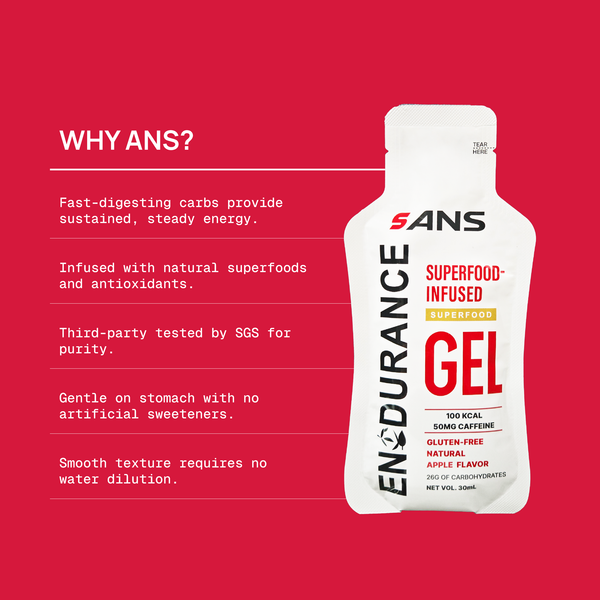
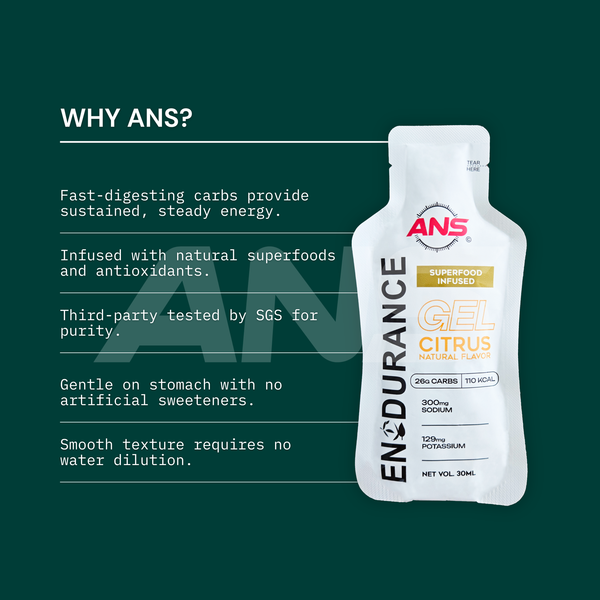
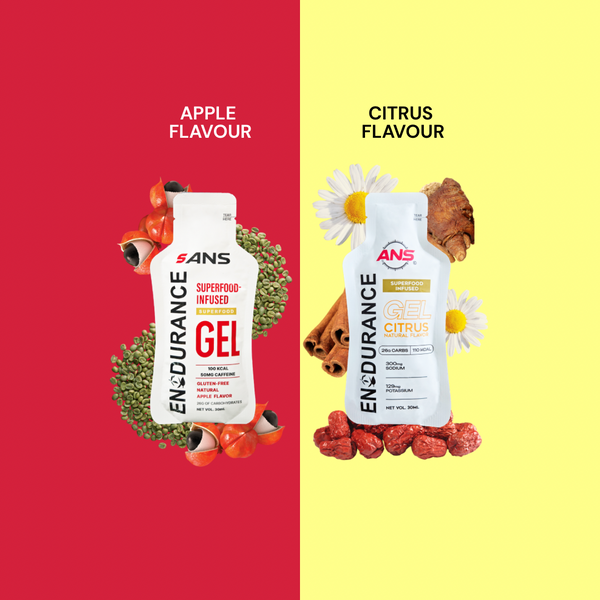
- Long Runs of One to Two Hours: Start with one gel an hour. Each ANS Superfood Energy Gel carries 26g of carbohydrate, so that gets you close to 30g, and you can build from there.
- Marathons and Long Runs of Two to Three Hours: Work towards about 60g an hour, which is a 26g gel about every 25 minutes.
- If Your Pace Is Easy: You burn less carbohydrate at a gentle pace, so you need less. A five-hour marathoner is unlikely to need 90g an hour.
Building Tolerance: Do Not Jump Straight to 90 Grams
Your stomach needs training just like your legs. Rehearse your race fuelling on your long runs, not for the first time on race morning.
- Step Up Slowly: If you take one gel an hour today, do not try three next weekend. Add a little at a time and give your stomach a few long runs at each level.
- Carry Water: Solid food and very concentrated carb drinks can slow down how much fluid you absorb, so wash your gels down.
- Respect the Heat: Stomach trouble is more likely in hot weather and when you are dehydrated. On a humid Singapore morning, that is most mornings.

Photo: SportPlus.sg / Isis Ang
Dial In Your Number with ATHLO+
- Work Out Your Race-Day Number: Enter your event and finish time in our race fuel calculator, and it tells you how many grams an hour to aim for, how many gels that is, and how often to take them.
- Compare Every Gel: The Nutrition collection lists the carbs and price per serving for every gel and electrolyte ATHLO+ stocks, including ANS Athletic Nutrition.
- Pack for Race Day: Gels, electrolytes and soft flasks sit together in the Race Day collection.
Ready to sort your sodium as well as your carbs? Read Electrolytes 101 next.
Sources
- Jeukendrup A. A Step Towards Personalized Sports Nutrition: Carbohydrate Intake During Exercise. Sports Medicine, 2014. The one-to-two-hour row in the table is our guidance between its bands.
- Jeukendrup A. Training the Gut for Athletes. Sports Medicine, 2017.
- Product details from the ANS Superfood Energy Gel page on ATHLO+, 2 November 2026.
Shop ANS Nutrition


More from News
 Apparel
Running Clothes for Hot Weather: What to Wear in Singapore’s HeatThe Short Version Singapore's humidity often tops 90% just before sunrise, so you will sweat heavily and your...Read →
 Massage Gun
 vs Foam Roller: Which Is Better for Muscle Recovery?Massage gun vs foam roller: which recovery tool is right for you? Compare localized percussive therapy against broad...Read →
 Garmin
Heart Rate Zones Explained: How to Train Smarter With Your Garmin Sports WatchStop turning easy runs into hard workouts. Learn how heart rate training zones work, how to set them...Read →