

Training Your Gut: How to Stop Stomach Issues on Long Runs
Shop the gear in this storyThe Short Version
- Stomach trouble on long runs is common: a 2017 review puts it at 30 to 50% of athletes regularly, and heat and dehydration make it worse.
- Your gut can be trained. Practising your race fuelling on long runs improves comfort, and a carb-rich diet can raise your gut's capacity to absorb glucose.
- Build up gradually, keep fibre and fat low before key runs, and do not mix your drinks too strong.
Kilometre 18 of a Sunday long run along East Coast Park, and your stomach has other ideas. The gel you took 20 minutes ago is sitting heavy, every stride sloshes, and you are already scanning ahead for the next toilet block. It is tempting to blame the gel and swear off fuelling for good.
That usually swaps one problem for another, because running out of carbohydrate on a long effort is its own kind of misery. The better fix is to train your stomach the way you train your legs. Here is your complete guide to training your gut: why runners get stomach problems, what the research says about training it, and a simple plan to build up on your long runs.
Gut Training at a Glance
| What the research says | What it means for your long runs |
|---|---|
| 30 to 50% of athletes have gut problems regularly | You are far from alone, and it is fixable |
| Heat and dehydration make symptoms more likely | Singapore long runs need a drinking plan as well as a fuel plan |
| Fibre, fat and very concentrated carb drinks are linked to more problems | Keep pre-run meals plain and do not over-mix your bottle |
| Stomach comfort improves with practice | Fuel on your long runs, not just on race day |
Source: Jeukendrup A, Training the Gut for Athletes, Sports Medicine, 2017.
Why Runners Get Stomach Problems
Sports scientist Asker Jeukendrup's 2017 review in Sports Medicine found that 30 to 50% of all athletes experience gut problems regularly. Symptoms such as bloating, cramping, diarrhoea and vomiting are common in endurance sports in particular.
The Causes Are Personal
The review is honest about how much is still unknown. The causes appear to be partly genetic and highly individual, which is why your training partner can take gels without a second thought while you cannot. The symptoms are more likely to occur, and get worse, in hot weather and when you are dehydrated.
What You Eat and Drink Plays a Part
The link with food is not always found, but some habits keep coming up: fibre intake, fat intake and highly concentrated carbohydrate solutions all seem to increase how often gut problems happen. Two common culprits are a bloated feeling as your stomach empties more slowly during long efforts, and diarrhoea from water being pulled into the gut.
Train your stomach the way you train your legs.
Your Gut Can Be Trained
The review's main point is encouraging: the gut is highly adaptable, and targeted training may improve how well you take in fuel while easing some, or all, of the symptoms.
Comfort Improves With Practice
In one study, trained runners drank a carbohydrate-electrolyte drink at about the same rate they were sweating, during 90 minutes of running. Their stomach comfort improved significantly as they practised those high intakes. Interestingly, their stomachs did not measurably empty any faster. They simply got used to it.
Carbs in Your Diet Matter Too
A high-carbohydrate diet increases the number and activity of the transporters that absorb glucose from your gut, called SGLT1, which allows more carbohydrate to be absorbed and used during exercise. In a study of 16 endurance-trained cyclists over 28 days, the group on the high-carbohydrate diet used more of the carbohydrate they took in during exercise. Jeukendrup concludes that athletes who are not already eating a high-carbohydrate diet can benefit substantially.
Know the Ceiling
Even a trained gut has limits. Carbohydrate use during exercise tops out at around 60g an hour from a single type of carbohydrate. Going higher only works with a blend, such as glucose with fructose, which use different transporters. For most long runs, 60g an hour is plenty.
A Simple Plan for Your Long Runs
The research does not give a set number of weeks, but it does advise you to practise your race nutrition strategy in training, and get used to higher volumes or higher carbohydrate intakes. A simple way to build it:
- Start on easy days: take a small amount, such as one gel an hour, on easy long runs, when your stomach has the least to deal with.
- Build the dose: over your next few long runs, move towards your race target. For runs of two to three hours, that is up to about 60g an hour.
- Rehearse race pace: once your stomach copes on easy runs, take your fuel during race-pace sections too.
- Keep notes: write down what you took, when, and how your stomach felt. Patterns show up quickly.
Turning That Into Gels
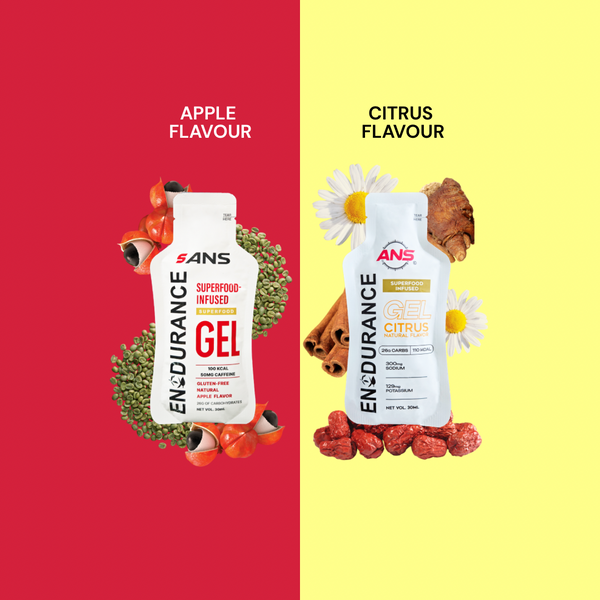
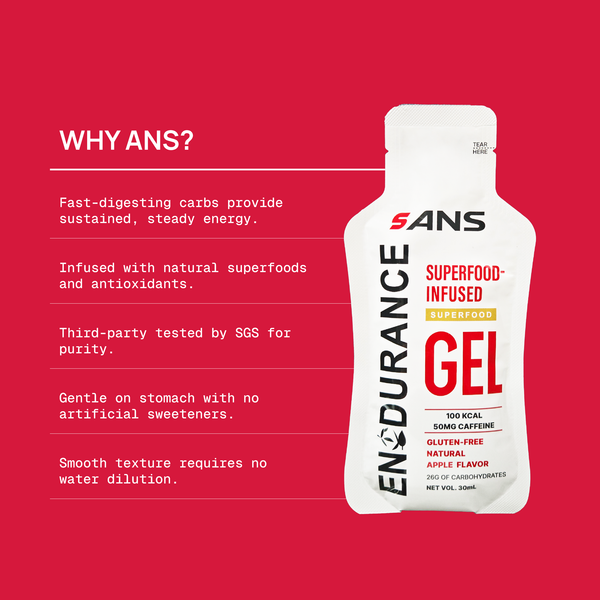
Each ANS Superfood Energy Gel carries 26g of carbohydrate, so one an hour is a gentle start and one about every 25 minutes gets you to 60g. The Apple gel gets its caffeine from guarana. If caffeine is one of your triggers, the Sour Citrus gel is caffeine-free.
The Habits That Help
- Plain meals before key runs: keep fibre and fat lower in the meal before a long run or race, since both are linked to more gut problems.
- Do not over-mix your drink: highly concentrated carbohydrate drinks are another of the habits linked to stomach trouble. Follow the label, or keep your carbs in gels and your bottle for fluid and salt.
- Stay ahead on fluid: dehydration makes symptoms worse, and Singapore heat makes dehydration easy. Our guide to calculating your sweat rate shows you how much you lose.
- Carry salt in your bottle, not sugar: one sachet of SUPERnatural+ SUPERSALTY in a 500ml SUPERflask gives you 1000mg of sodium with your water.
If your symptoms are severe, include blood, or do not settle with these changes, see a doctor rather than training through them.
Train Your Gut with ATHLO+
The ANS Apple and Citrus variety bundle gives you 10 of each gel, enough to test caffeine and no caffeine across several long runs. Add SUPERSALTY and a SUPERflask, and you have the kit to rehearse race day every weekend. Compare every gel we stock in the Nutrition collection.
Ready to set your carb target? Read how many carbs you actually need per hour of exercise next.
Sources
- Jeukendrup A. Training the Gut for Athletes. Sports Medicine, 2017. The long-run plan above is our suggestion built on its advice; the review does not set a number of weeks.
- Jeukendrup A. A Step Towards Personalized Sports Nutrition: Carbohydrate Intake During Exercise. Sports Medicine, 2014.
- Product details from the ANS and SUPERnatural+ pages on ATHLO+, 2 November 2026.



More from Learn
 ANS Nutrition
Gels vs Chews vs Drink Mix: Which Endurance Fuel Suits You?Gels, chews and carb drink mixes compared for runners: what each does well, what to watch for, the...Read →
 ANS Nutrition
Your First Half Marathon: The Complete Race-Day Fuelling and Nutrition PlanWhat to eat the night before, when to have breakfast before a 4:30am flag-off, how many gels to...Read →
 ANS Nutrition
How to Fuel a Long Run: The Complete Runner’s Guide to Energy Gels and CarbsHow many carbs per hour to take on a long run, when to take your gels and how...Read →